
Allan Fraser reached another milestone in his harness racing career at Inverness Raceway on Sunday – picking up his first two career driving wins – back-to-back. This is his second win, in race two, on a charge up the middle with 13-year-old gelding Old Buck in 2:04.
-by Bill Dunphy
“I kind of surprised everybody, even myself!”
That was Al Fraser’s reaction to winning back-to-back races on Sunday for his first career driving wins at Inverness Raceway.
Driving two horses that he trains and shares ownership with Lisa Hanscombe, Fraser opened the seven-dash card with a win with three-year-old filly Luna Bets, first-up from third approaching the half and scored in 2:05.4, with Miss Chili Pepper (Keigan Madden) tracking in second and the popular pacesetter, JW Flatout (Redmond Doucet), settling for third.
Fraser won his very next drive with 13-year-old pacer Old Buck, prevailing in a backstretch battle between the co-favourites, Elm Grove Support (Rodney Gillis) and Rankinville Shamus (Sandy MacNeil).
Old Buck had given the 55-year-old Inverness horseman his first training tally back on Aug. 5, with Monica Sutherland driving for that milestone moment, and the pacer completed his first driving double on Sunday winning in 2:04 by a quarter-length.
“It was pretty surreal actually,” Fraser said. “You think you’re going to win in the 13 drives before that. But they race exceptionally well on Sunday. The filly was getting consistently better, taking a little off her time every time out. And I thought Old Buck was going to quit on me at the seven-eights but he came on again in the stretch.”
And like everyone who has ever won their first race, a bucket of cold water was waiting for Fraser when he got back to the barn, courtesy of Erland Campbell.
Meanwhile, trainer D.F. Beaton’s Shir Gain pulled off the upset as the longest shot on the board in this week’s winners-over pace, getting to the front late and holding off 1-9 young gun Captain Tate.
Shir Gain and driver Rodney Gillis bided their time in the pocket behind the usual pacesetter McLand (Danny Gillis).
After following the leader through panels of :30.1, 1:00.1 and 1:29, Shir Gain slipped out in front of the stalled Sea Laird (Zach Mullins) first-up and took a late lead en route to the 14-1 upset in 1:59.1.
The favoured sophomore colt, Captain Tate (Walter Walker), a dead-heat top-class winner last week with Sea Laird, found clearance from the backfield too late towards the pylons and finished a length behind Shir Gain in this week’s $2,285 feature, edging out Philthy Phil (Redmond Doucet) and McLand in a photo for place.
Overlooked at the betting windows after a first-over journey landed him just a quarter-length behind last week’s top pair, Shir Gain rewarded his backers with a $31.70 payout for every $2 win ticket.
Shir Gain, an eight-year-old gelding by Blue Burner out of Shirley Hall, has won six of his 23 races this year and now boasts 25 career victories with $92,296 in earnings. The 100th anniversary season of live harness racing at Inverness Raceway will wrap up next Sunday, Oct. 25.

Rose Morrison gets a hug from Breanndán Ó Beaglaoich as the artists take their final bows. (l to r) Dawn Beaton, Margie Beaton, Ryan MacNeil, Kenneth MacKenzie, Dave Gunning, Rose Morrison, Breanndán Ó Beaglaoich, Graham Marshall, Kathleen MacInnes, Sarah Prosper, and Jenny MacKenzie.
-by Beverley Phillips
Some Celtic Colours concerts are a party, and others are a contemplative experience that can bring the audience to tears.
“Holding Sand,” the concert at Strathspey Performing Arts Centre on October 14th, was described as the latter by some of the concert-goers.
Inspired by Rose Morrison’s artist residency on Sable Island, the show featured songs, dance, and spoken storytelling from local and international artists.
Wendy Bergfeldt, host of CBC Radio’s Main Street, was the host of the evening, opening and closing each half of the concert. Hung from the ceiling and gathered on the stage floor were 1801 paper cranes, which in the Celtic tradition, Bergfeldt said, “represent knowledge from another plane, another place.” She set the stage for the contemplative evening by inviting the audience to go “on a journey of imagination, where memories drift like sand and where imagination swirls like the currents.”
Performing on stage with Morrison were Mi’kmaw singer Graham Marshall, Dave Gunning, Breanndán Ó Beaglaoich, a signer/storyteller/accordian player from Ireland, Gaelic singer Kathleen MacInnes from Scotland, Ryan MacNeil on piano and uillean pipes, and Kenneth MacKenzie on fiddle and pipes. Margie and Dawn Beaton brought their stepdancing, and contemporary dancer Jenny MacKenzie and Mi’kmaw dancer Sarah Prosper shared their perspectives.
The evening centred on the song and themes of “Holding sand.” The song was written by Morrison as she prepared to head to Sable Island. The song is about connection, stewardship, and the shared responsibility to protect the environment. Marshall spoke about community and the need for unity, which came through when he sang with MacInnes, bringing the Mi’kmaw and Scottish communities together through music. The evening stewarded culture, whether it was Ó Beaglaoich reading a story in Gaelic, MacNeil on the piano, or MacKenzie on the bagpipes. MacInnes offered haunting and beautiful sung Gaelic prayers and Gunning gave some political commentary. He spoke of the value of local media in an age of misinformation, but also of being able to get along with neighbours with whom he had very different political opinions.
Care for the environment hung from the ceiling, as four whale bones were illuminated as a reminder of life in the seas.
It all combined to form a moving, and for some, spiritual evening, with a powerful message. As the lyrics of Holding Sand say,
“We walked along our father’s path
Like the ants through marram grass
All in order, so steadfast
One was first and one was last
Damn the greed that’s everywhere
The local grubs and billionaires
Pound the cloth and turn to prayer
No one can own this place.
Within the wind that moves the ocean
Wave on wave in constant motion
Before all is lost
I’ll keep working with my hands
On this little piece of land
I’m holding sand.”

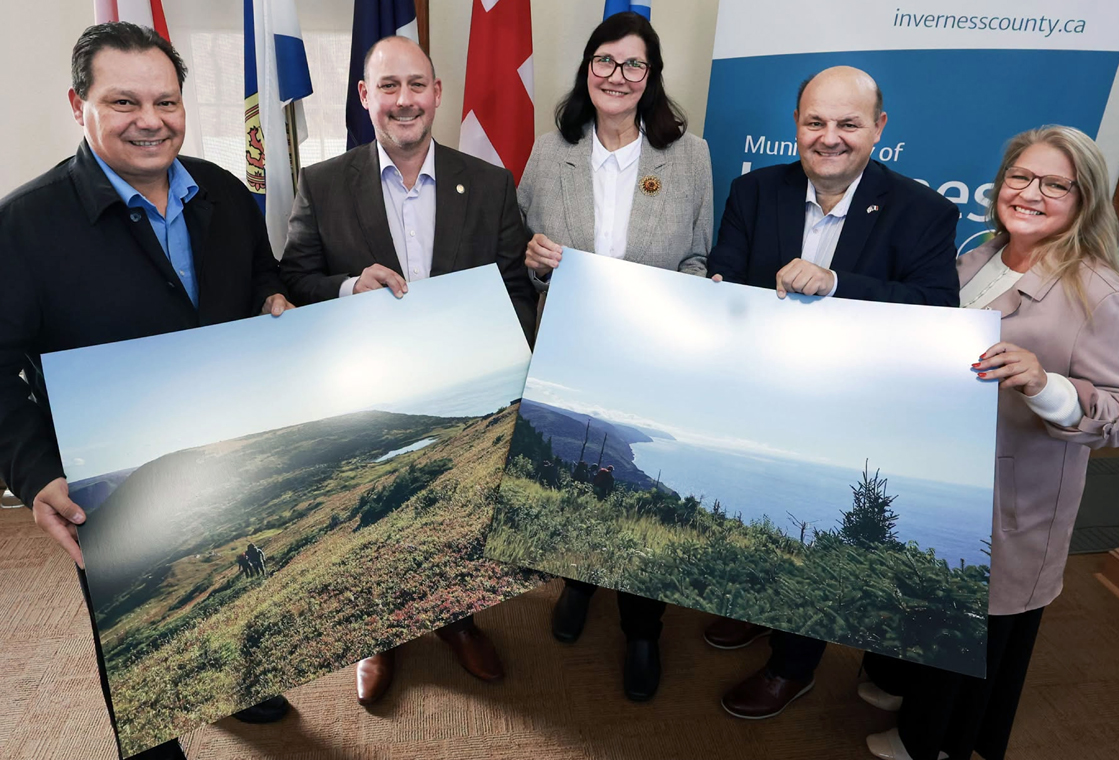
From the left: Robert Bernard, Chair of the Destination Cape Breton board of directors and Executive Director of the NS Indigenous Tourism Enterprise Network, Minister of Environment and Climate Change, Tim Halman, Warden Bonny MacIsaac, MLA Claude Bourgeois, amd MLA Dianne Timmins at the announcement.
-by April MacDonald
You could feel the energy in the room in the council chambers in Port Hood as members of both provincial and municipal governments, special guests, and the Seawall committee association gathered to bring this unbelievable endeavour one step closer.
Dianne Timmins, MLA for Victoria-The Lake was the emcee for the event.
She asked all those who had been steadfastly pushing this project forward for 15 years to please stand up.
“This is your moment,” she said.
“We are the public face but it is the folks on the ground that make things happen,” said Timothy Halman, minister of environment and climate change.
He said that it was five years ago that this came across his desk.
He explained that he has lived in every nook and cranny across this great country but nothing compares to Cape Breton Island.
“You have the best scenic vistas in the world…with rugged coastlines and vast wilderness. Plus there is no more welcoming place than Cape Breton Island. It is truly a special place,” said Minister Halman.
“This is one of the province’s crown jewels,” he added.
Nova Scotians and visitors to the province will soon be able to experience a new world-class coastal hiking experience in northern Cape Breton.
The Jajiktek Seawall Trail through the Polletts Cove-Aspy Fault Wilderness Area will give hikers access to one of Nova Scotia’s most spectacular and remote wilderness areas in a way that ensures the ongoing protection of the area.
“It’s precisely the place we protect because it’s so special…and done in a thoughtful and responsible way,” added Halman.
The trail, expected to open in about two years, will be a marquee destination for those seeking a premium wilderness hiking experience, further strengthening Cape Breton's tourism sector.
Halman announced two agreements on Monday, October 19th, that will allow the Municipality of the County of Inverness to build and manage the trail.
“We are pleased to work with the Municipality of the County of Inverness to advance the communities’ vision of creating a world-class, guided hiking experience through one of the most beautiful places on the planet,” said Minister Halman.
“The Jajiktek Seawall Trail will give people a unique opportunity to experience one of Nova Scotia’s most spectacular and special protected areas, while ensuring conservation remains at the heart of the project. It shows that protecting our natural areas while creating opportunities for people to experience and appreciate them can go hand in hand,” he added.
Hikers will cross about 48 kilometres offering scenic coastal vistas, mountainous terrain, rugged wilderness and pristine nature. The experience will take four days to complete, and hikers will spend the night in camping huts at three locations along the trail.
“The hike will be a magical experience; something like this should be experienced firsthand. It’s more than just a concept, it becomes profoundly personal. This project is also about community,” said Halman.
The minister took the time to recognize Warden Bonny MacIsaac for her unwavering support of this Seawall Trail project.
“This experience will stay with you forever,” he closed.
“The Jajiktek Seawall Trail represents an extraordinary opportunity for both Inverness and Victoria counties and Cape Breton Island. This project is about much more than creating a world-class hiking destination. It is about supporting the long-term economic vitality of our rural communities, creating opportunities for local businesses and entrepreneurs, and showcasing the natural and cultural heritage that makes this region so special,” said Bonny MacIsaac, warden, Municipality of the County of Inverness.
The warden also made a point to recognize two individuals: Elder Judy Googoo and Vincent vanZutphen for the wisdom and passion they played in pushing this project forward.
The Jajiktek Seawall Trail is expected to generate economic benefits throughout its construction, creating opportunities for local contractors, trades people, and suppliers. After it opens, the trail is anticipated to become a significant tourism attraction that will support local accommodations, restaurants, transportation providers, guides and other businesses, while encouraging longer visitor stays, extending the tourism season and creating new economic opportunities for communities throughout northern Cape Breton and beyond.
MLA Claude Bourgeois said that he had been on the trail committee for five years and spoke to the population understanding the necessity of hiking the wilderness, especially after the COVID pandemic.
“Tourism season is extended longer than it ever has been,” he said.
“I knew Vinnie myself and this was in his DNA. My hope is that people remember him when they hike this trail,” said Bourgeois.
“People already come to Cape Breton to get outside and explore, and this trail will give them one more reason to make the trip. The Jajiktek Seawall Trail will take hikers through some of the most beautiful coastline in the world – the kind of unforgettable journey they’ll talk about for years. We’re proud to invest in a project that will draw more tourists to northern Cape Breton, support local businesses, and give both visitors and Nova Scotians a new way to experience this part of the province,” said Dave Ritcey, Minister of Communities, Culture, Tourism and Heritage.
Robert Bernard said he was wearing multiple hats and said that as president of Destination Cape Breton this project is a win for the Island.
“The Jajiktek Seawall Trail will be a bucket-list experience that will draw destination hikers to Cape Breton Island from around the world. A four-day hike through one of the most remote and beautiful stretches of the coast gives visitors a reason to stay longer, which aligns with our primary goal of extending the length of stay. We’re looking forward to its opening,” said Terry Smith, CEO, Destination Cape Breton, who was not present for the event but sent his words.
“The size, magnitude and scope of a project like this requires provincial and federal funding,” said Bernard.
“This trail celebrates the many beautiful cultures that make up Unimaki…it began as a Northern Community project and the Mi’kmaw people were brought in quickly,” he said.
Bernard said that this project is much bigger than a path through the woods.
He spoke to the potential of having Mi’kmaw guides to tell their story of this land and of that area.
He could not stress enough how important it is today to have the inclusion of the Mi’kmaw people.
He also thanks the steadfast support from the municipality of the county of Inverness.
Visionaries like Ray Fraser, Derek MacLellan, Keith Bain, David Williams or “Seawall Dave” were recognized for doing “test trails” and for always pushing the project to where they are today.
The Province has invested about $7 million to help design and build the trail and camping huts.
Jajiktek is a Mi’kmaw word that means crouching down and standing up as you move along a difficult route close to water
The Jajiktek Seawall Trail will begin near Red River, Inverness County, and end in Meat Cove, close to the Victoria County line
About 86 per cent (42 kilometres) of the trail will be within the Polletts Cove-Aspy Fault Wilderness Area; the remaining six kilometres will cross lands administered by the Department of Public Works, the Nova Scotia Nature Trust and the federal Department of National Defense.
The municipality will continue to work with community partners and stakeholders to set up a not-for-profit governance structure that will oversee the long-term operation, maintenance, and promotion of the trail once it opens.
- Lupine’s Ride travels through Inverness County
- Dr. Michel T. Chiasson ran the 2026 Berlin Marathon – an inspiration to many
- Premier Houston has a great week for new economic development
- Part 3: Have you been scammed? What to do next
- The Blue Mountain Ceilidh in Glendale was "rockin'"
- More Celtic Colours events...
- The Oxeye Daisy Diary: Chapter 3: Casper
- Inverness Rebels high school hockey team folds
- U18 AA Whitecaps open season with five-point weekend
- U18 Major Islander rout the Rush to maintain league lead
- U13 AAA Islanders show early promise in opening game

The Inverness Oran is a locally owned and operated newspaper publication with offices located in the county of Inverness, Nova Scotia, Canada. Printed 52 times per year, The Inverness Oran caters to residents of Cape Breton Island, Nova Scotia as well as national and international readers.
Readers can take advantage of a flexible subscription package available for 3-months, 6-months or 12-months periods, available in a Print Version, a Digital Version, or both. First published in 1976, The Inverness Oran continues to serve and reflect residents and communities of Inverness County.